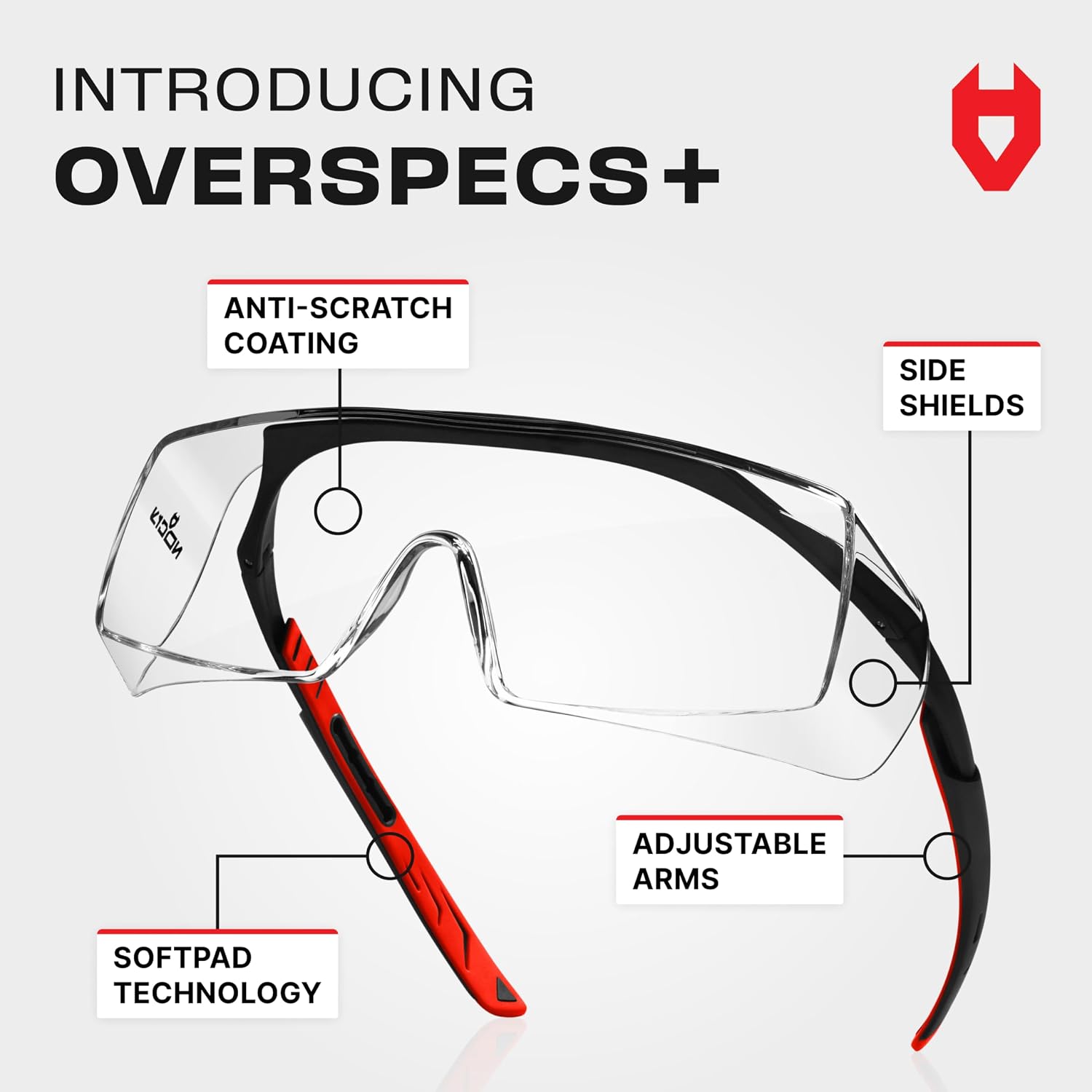
If you wear prescription eyeglasses, you already know the frustration: you walk into your shop, reach for a pair of safety glasses, and immediately face a choice between protecting your eyes and actually being able to see what you’re doing. Standard safety eyewear is designed for bare faces. Put a pair over your prescription frames and you get pressure points on your temples, a fogged-up lens within minutes, and a gap around the bridge where a wood chip or grinding spark can still find your eye. Over-the-glasses safety eyewear — usually called OTG specs — is built specifically to solve this problem. They have a wider, deeper frame profile that cups around your prescription glasses without crushing them, and venting systems designed to keep air moving so fog doesn’t build up. This guide will help you pick the right pair, explain the one rating standard that determines whether they’re actually protective, and walk through the real-world fit variables that trip up even experienced buyers.
What ANSI Z87.1 Actually Means — and Why “Safety Glasses” Without It Is Just Marketing
Before we talk about specific OTG models, let’s nail down the standard that determines whether a pair of safety glasses belongs in your shop at all.
ANSI/ISEA Z87.1-2020 — published by the American National Standards Institute in partnership with the International Safety Equipment Association — is the benchmark for occupational eye and face protection in the United States. In plain terms, it defines exactly how hard a lens must be hit, how much UV it can transmit, how resistant it has to be to fogging, and how the frame must hold together under impact before a product can be sold as compliant safety eyewear. Per OSHA’s Eye and Face Protection eTool, employers are required to provide eye protection that meets this standard or an equivalent — meaning anything without the Z87 marking on the lens and frame is not OSHA-recognized PPE, full stop, regardless of how rugged it looks.
The two designations you’ll see most often:
- Z87 (or Z87+): The ”+” means the lens passed high-velocity impact testing — a quarter-inch steel ball fired at the lens at high speed. This is the version you want for any grinding, machining, fastening, or projectile-risk environment.
- Z87 (no plus): Basic impact rating only — tested by dropping a one-inch steel ball onto the lens from 50 inches. Adequate for splash hazard work like chemical handling, but not for grinder sparks or flying debris.
Look for both markings physically stamped or molded into the lens and on the frame or temple. If a pair of OTG specs only has the mark on the packaging, that’s a red flag — proper certified eyewear carries the mark on the hardware itself, as required by the standard.
The OTG Fit Problem: Why This Category Has a Higher Failure Rate Than Standard Safety Glasses
ISHN’s 2024 analysis of OTG eyewear noted that the single biggest driver of workers abandoning over-the-glass specs is discomfort from poor fit — not lens quality, not fogging, but the physical experience of wearing them for more than 30 minutes. This matters because a pair of safety glasses that gets pulled off and set on the workbench is doing zero protection work.
Here’s what to evaluate before you buy:
Frame depth and width clearance. OTG specs need enough interior cavity depth and width to clear your prescription frames without the temples of your Rx glasses digging into the OTG’s inner surface. Larger prescription frames — anything approaching a 55mm+ lens width — can be particularly troublesome with entry-level OTG designs. Brands like Pyramex (the OTS series) and Uvex (the Astrospec OTG 3001) publish interior cavity dimensions; cross-reference those against your prescription frame dimensions before ordering.
Temple arm routing. Standard OTG specs have a channel or notch at the inside of each temple arm to route the arms of your prescription glasses through without creating pressure points. Cheaper designs skip this entirely and just build a wider frame shell — which works until you’re an hour into a finishing session and the lateral pressure becomes genuinely painful. Owners consistently flag this as the failure mode in aggregate reviews of budget OTG designs.
Facial hair and face shape. If you’re wearing a full beard, the soft nose bridge and lower facial seal of OTG specs can leave a gap where particulates enter. This is less of a concern with chemical splash (where you’d use a goggle, not a spectacle) but real in a dusty woodworking or drywall environment. Wrap-around OTG goggle styles — like the Uvex Stealth OTG or the 3M SecureFit 400 series — provide a foam or soft-face gasket that seats more consistently against varied face contours. Safety and Health Magazine’s 2023 feature on prescription-wearer PPE specifically called out the gasket-style goggle as the better choice for anyone with significant facial hair or an atypical face shape.
Weight. Adding an OTG frame over existing Rx glasses puts more mass on the bridge of your nose. Over a multi-hour work session, this compounds into real fatigue. Polycarbonate OTG frames in the 30–40 gram range are the sweet spot. Published specs on lighter models like the Gateway Safety Xtreme OTG come in around 28–32 grams depending on configuration.
Fog: The Problem That Makes People Give Up on OTG Specs
Fogging is to OTG eyewear what discomfort is to respirators — the reason people rationalize not wearing it. The physics are straightforward: your prescription glasses are sitting closer to your face than a bare lens would be, which traps a larger volume of warm air between your face and the OTG outer lens. When that air hits the cooler lens surface, moisture condenses. Standard anti-fog coatings help, but airflow management is the real solution.
Indirect vs. direct vent designs. Most Z87.1-rated OTG spectacles use indirect venting — small channels positioned so air circulates through the frame without creating a direct line for a liquid splash or particle to reach your eye. Direct vents allow more airflow but are generally rated only for impact hazards, not chemical or dust exposure. Know your environment and match accordingly.
Anti-fog coatings — what the specs actually tell you. Z87.1-2020 includes an anti-fog test (derived from EN 168, the European equivalent standard — the European Norm governing lens coating performance). A lens that passes this test shows no fogging after 8 seconds of exposure to warm moisture. Look for “Z87 AF” marked on the lens — that “AF” designator confirms the lens cleared this specific test. Without it, the manufacturer’s anti-fog claim is marketing language, not a verified specification.
Practical mitigation. Anti-fog sprays and wipes (Rain-X Safety Eyewear Anti-Fog, Optix 55 Fog Gone) extend coating life but aren’t a substitute for a proper venting design. Owners of the Uvex Stealth OTG consistently report that the combination of a perforated foam gasket and indirect venting performs better in high-exertion tasks than coatings alone on sealed-frame designs.
By the Numbers: OTG Spec Comparison at Three Price Points
| Model | Impact Rating | Anti-Fog Designation | Interior Width (approx.) | Street Price Range |
|---|---|---|---|---|
| Pyramex OTS Plus | Z87+ | AF coating (unverified by standard) | ~145mm | $8–$14 |
| Uvex Astrospec OTG 3001 | Z87+ | Z87 AF (standard-verified) | ~148mm | $18–$28 |
| Uvex Stealth OTG Goggle | Z87+ | Z87 AF + foam gasket | ~150mm interior cavity | $22–$35 |
| 3M SecureFit 400 OTG | Z87+ | Z87 AF | ~152mm | $16–$26 |
Prices reflect May 2026 market conditions across safety-equipment distributors. Street pricing varies by quantity and distributor.
Making the Call: If X, Then Y Decision Rules
You’ve got the framework. Here’s how to translate it into a purchase decision without second-guessing yourself.
If you work in a grinding, machining, or projectile-risk environment: You need Z87+ (the ”+” is non-negotiable). Do not accept Z87-only in this context regardless of price. The Uvex Astrospec OTG 3001 and 3M SecureFit 400 are the two designs that consistently earn recognition from safety professionals for hitting the Z87+ and AF designations at a price point that doesn’t discourage replacement when lenses scratch.
If you have a full beard or an atypical face shape: Move straight to a goggle-style OTG (Uvex Stealth OTG is the most commonly specified in this category). The foam-gasket perimeter contact is the only reliable way to manage fit variation across face geometries. Spectacle-style OTG frames rely on a predictable facial contour that facial hair disrupts.
If you’re outfitting a crew rather than just yourself: Standardize on one OTG model, buy in bulk from a distributor (Grainger, Fastenal, or direct from a Uvex or 3M authorized distributor), and spec the replacement lens separately so workers swap lenses rather than whole frames. NIOSH’s workplace eye safety publication (DHHS Publication No. 96-102) emphasizes that compliance rates rise meaningfully when workers aren’t expected to supply their own PPE — providing a standardized, comfortable OTG spec on the tool cart is the operational move.
If you’re in a dusty woodworking or drywall environment (not chemical splash, not grinding): You have more flexibility. An indirect-vent Z87+ with verified AF designation handles this environment well. Prioritize weight and comfort over the most aggressive impact spec, since the duration of wear in a finishing or drywall session is typically longer than a grinding operation.
If the $8 OTG option is tempting: It’s a reasonable entry point for occasional-use scenarios where you’re not in a high-velocity impact environment. But cross-check the markings physically on the lens and frame — not just the box — and plan to replace them aggressively. Owners consistently report that budget-tier anti-fog coatings degrade noticeably within a few months of regular use, and a scratched or severely fogged lens becomes a compliance and visibility problem regardless of its original rating.
The Bottom Line
OTG safety eyewear is one of those product categories where the gap between a $12 option and a $30 option is meaningful — not because the expensive one is better-branded, but because the verified anti-fog designation, the interior cavity geometry, and the indirect-vent design genuinely perform differently over a four-hour shop session. Per OSHA’s guidance, any eye protection you select must meet ANSI Z87.1; the additional detail work is figuring out which specific design survives contact with your actual face, your actual environment, and your actual workday.
Check the lens and frame for the Z87+ stamp. Look for “AF” if fogging is a concern — which it almost always is with OTG designs. Match the vent style to your hazard type. And if you’re buying for a crew, standardize rather than letting workers mix-and-match, because the pair that fits nobody is the pair that sits on the shelf.