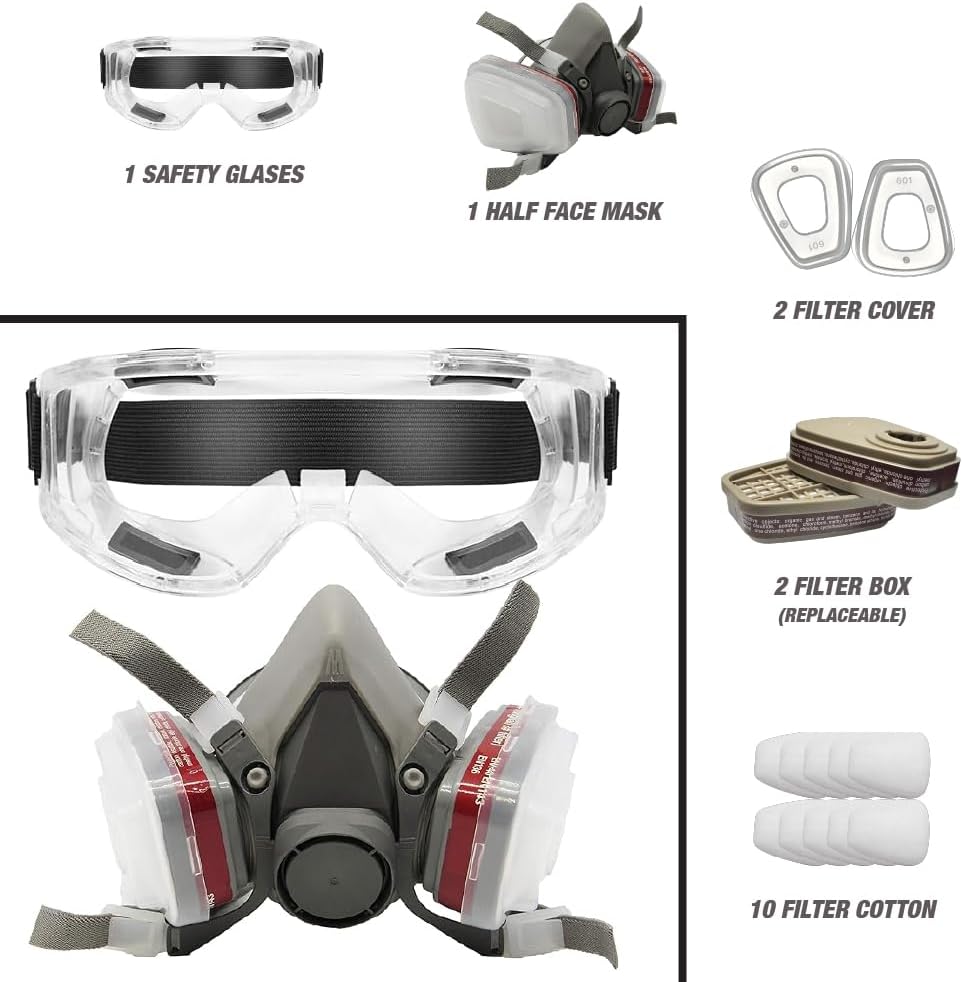
If you’ve ever grabbed a box off the shelf labeled “Safety Starter Kit” and assumed the respirator and safety glasses inside were designed to play nicely together, you’re not alone — and you’re not wrong to question it later. A respirator is a device you wear over your nose and mouth to filter out harmful particles, vapors, or fumes before they reach your lungs. Safety glasses are the impact- and splash-rated lenses (they’re built to a different standard than sunglasses or prescription frames) that protect your eyes from flying debris, chemical splatter, and UV. In a dusty workshop or a spray-finishing booth, you need both working at the same time, on the same face. The problem is that combining them without thinking through the fit is how you end up with a mask that leaks air around a foam seal because your glasses temple arms broke the gasket seal — and protection that looks complete but isn’t. This guide walks you through exactly what to check before you buy a combo kit, and when buying both pieces separately is the smarter call.
| EDITOR'S PICKReusable Half Face Cover Set | Mid-tier[LAUCO Premium Respirator Kit](https://www.amazon.com/dp/B0D9R8H8T7?tag=greenflower20-20) -… | Budget pick3M Rugged Comfort Half Facepiec… | |
|---|---|---|---|
| NIOSH rated | — | — | ✓ |
| Faceseal material | — | — | Silicone |
| Glasses included | — | ✓ | — |
| Cool Flow Valve | — | — | ✓ |
| Price | $37.99 | $29.99 | $28.31 |
| See on Amazon → | See on Amazon → | See on Amazon → |
Why Combo Kits Exist — and Where They Fall Short
The pitch is reasonable: one SKU, matched branding, usually a slight price break versus buying both pieces à la carte. For a job-site coordinator standardizing PPE across a crew, a kit simplifies purchasing and removes the guesswork of “will these work together?” For a hobbyist woodworker who needs occasional dust protection and eye protection, a kit is a sensible on-ramp.
The shortfall is that “matched branding” is not the same as “engineered to coexist.” Most combo kits pair a half-mask respirator — a reusable silicone or rubber facepiece that covers the nose and mouth and accepts screw-in filter cartridges — with a set of safety glasses. The respirator seal runs across the nose bridge and over the cheekbones. That’s precisely where safety glasses temple arms and nosepieces sit. When the two compete for the same real estate on your face, something loses: either the respirator’s face seal gaps at the top (leaking unfiltered air), or the glasses sit uncomfortably canted, reducing peripheral vision.
The fix isn’t avoiding combo kits — it’s knowing which designs account for this conflict and which ones ignore it.
Per the OSHA Respiratory Protection Standard (29 CFR 1910.134), any tight-fitting respirator must achieve a proper seal against the face to provide its rated level of protection. The standard explicitly notes that eyewear must not interfere with the face-seal. That’s a regulation, not just a preference.
The Standards You’re Actually Buying
Before comparing kits, you need to know what the labels mean. Two ratings govern the pieces in any combo kit.
On the respirator side: NIOSH approval ratings. The National Institute for Occupational Safety and Health (NIOSH) tests and approves respirator cartridges and filtering facepieces. The most common designations you’ll see are:
- N95 — filters at least 95% of airborne particles; the “N” means it is not oil-resistant. Fine for wood dust, drywall, and general construction particulate.
- P100 — filters at least 99.97% of particles and is resistant to oil-based aerosols. The standard for lead abatement, spray painting with oil-based coatings, and any task where mist or oil aerosols are present.
- OV (Organic Vapor) cartridges — paired with a half-mask body to capture solvent fumes, lacquers, and VOCs (volatile organic compounds — the chemical gases that evaporate from finishes and adhesives).
NIOSH publishes its approved respirator list through CDC/NIOSH as the “NIOSH Approved Particulate Filtering Facepiece Respirators” database. If a respirator in your combo kit doesn’t have a NIOSH TC number printed on the body or packaging, it is not certified.
On the eyewear side: ANSI/ISEA Z87.1-2020. This is the American National Standard for occupational eye protection. It means the lens survived a high-mass impact test and a high-velocity projectile test. Glasses marked Z87+ (the plus sign matters) passed the more demanding high-impact test required for industrial use. Basic Z87.1 without the plus sign is the lower-tier rating. Per the ANSI/ISEA Z87.1-2020 standard, the marking must appear on both the lens and the frame to count.
By the Numbers
| Rating | What It Filters | Typical Use Case | Approx. Cost (cartridge pair) |
|---|---|---|---|
| N95 (disposable FFR) | 95% of particles ≥0.3 microns | Wood dust, drywall sanding | $2–$6/unit |
| P100 half-mask cartridge | 99.97% of particles + oil aerosols | Lead paint, spray finishing | $10–$20/pair |
| OV/P100 combo cartridge | Particles + organic vapors | Auto-body work, lacquer application | $15–$30/pair |
| Z87+ safety lens | High-impact rated | Grinding, cutting, spray work | $15–$60/frame |
The Fit Problem — and How Combo Kits Either Solve or Ignore It
Here’s the practical issue most combo-kit marketing glosses over: half-mask respirators and safety glasses fight over your nose bridge.
A half-mask’s upper seal is a soft bead that runs from one cheekbone, over the nose, and down to the other cheekbone. Safety glasses rest on the same nose bridge and run temple arms over the same cheek area where the mask’s upper seal sits. When temple arms press down on the mask’s silicone flange, they create a pressure ridge that breaks the seal — pulling it slightly away from the face on either side of the arm.
There are three legitimate engineering solutions, and the best combo kits use at least one of them:
1. Low-profile or wire-temple glasses. Some eyewear included in combo kits (or designed to pair with respirators) uses thin wire temples that minimize the footprint where they cross the mask seal. Uvex and Pyramex both make models specifically noted for respirator compatibility. Wire temples don’t eliminate the interference, but they reduce it significantly.
2. Goggle-style eyewear. Goggles that seal around the eye socket sit entirely above or around the respirator’s upper seal, avoiding the conflict entirely. Many professional auto-body and chemical-handling combo kits default to indirect-vent goggles for this reason. The trade-off is heat, fogging, and reduced peripheral vision — real annoyances on long shifts.
3. Mask designs with recessed nose bridges. Some half-mask designs — notably certain 3M 6500 Series and Moldex 7000 Series configurations — have a contoured nose bridge with a lower sealing profile that leaves more clearance for glasses temple arms. Owners in long-run reviews consistently call out this feature as a meaningful improvement over flat-bridged masks for glasses wearers.
What to check on any combo kit you’re considering: Look at the included glasses and ask whether the temple arms are thin, whether the mask body has a recessed or articulated nose piece, and whether the manufacturer explicitly claims compatibility. If the kit’s product page or packaging says nothing about eyewear compatibility, assume it wasn’t engineered for it.
Safety+Health Magazine’s overview of respirator fit testing notes that any eyewear worn with a tight-fitting respirator should be evaluated as part of fit testing, not assumed to be neutral.
When to Buy a Combo Kit vs. Buy Separately
This is the decision frame that actually matters. Run through these conditions before you add to cart.
Buy the combo kit if:
- You’re outfitting a crew for a single task type (e.g., drywall finishing, general carpentry) and need standardized PPE fast. Combo kits simplify procurement and reduce the chance someone shows up with mismatched gear.
- The task is intermittent — you’re not wearing both pieces for more than two hours at a stretch. Fit-related seal degradation matters much less when you’re pulling the mask on for a 20-minute cut session.
- The kit explicitly calls out glasses-respirator compatibility and uses low-profile temple designs or goggle-style eyewear.
- Your budget is genuinely constrained and the alternative is one person buying glasses, another buying a mask, and nobody coordinating.
Buy separately if:
- You wear prescription glasses. No combo kit is designed for Rx frames, and trying to make one work is a compromised seal waiting to happen. Your correct path: a half-mask with a recessed nose bridge, paired with Rx-compatible safety glasses or over-the-glass (OTG) safety spectacles, fitted by trying both on simultaneously before committing.
- You have a beard or significant facial hair. Per OSHA 1910.134, tight-fitting respirators cannot achieve a proper seal over facial hair that crosses the seal line. This is non-negotiable. If this applies to you, the mask in any combo kit is not your correct solution — loose-fitting powered air-purifying respirators (PAPRs) are — and the glasses choice becomes a separate question.
- You’re doing different task types on the same day (grinding in the morning, spray finishing in the afternoon). You’ll need different cartridge types, and combo kits rarely include both. Buy the mask body and multiple cartridge sets separately; your safety glasses selection is then independent.
- You’re spending $150 or more on eye protection. At that price point — Wiley X, Uvex Pheos CX2, or Bolle Cobra-grade optics — you’ve already made a deliberate eyewear decision. Don’t subordinate that choice to whatever glasses ship in a box with a mid-grade mask.
What to Prioritize in Spec Comparison
When you’re narrowing down to two or three kits, here’s the short checklist drawn from published specifications and owner feedback patterns:
Respirator body: Look for NIOSH TC number on the facepiece (not just the cartridge). Silicone facepieces consistently outperform PVC or rubber in owner-reported comfort over multi-hour sessions. Check whether the manufacturer lists compatible cartridge types — a flexible cartridge ecosystem means the mask body remains useful as your tasks change.
Glasses: Confirm Z87+ marking on both lens and frame. Anti-fog coating matters enormously for respirator pairings, because the exhaled air that escapes upward hits the lens. Polycarbonate lenses are the baseline for impact resistance; some premium kits include trivex lenses with better optical clarity at a modest weight premium.
Temple arm profile: Thin wire or cable temples are the practical tell that someone thought about respirator compatibility. Bulky plastic temples on an otherwise solid mask body is a signal the kit was assembled from available components rather than engineered as a system.
Storage and replacement parts availability: A combo kit that ships in a fitted case and clearly identifies replacement cartridge part numbers is a kit from a manufacturer treating this as a system. One that ships in a poly bag with minimal documentation is a commodity bundle.
The Bottom Line
Combo kits are a legitimate time-saver when the task is consistent, the pairing was engineered rather than assembled for price, and you don’t have complicating factors like prescription lenses or facial hair. The NIOSH TC number on the respirator and the Z87+ marking on the glasses are non-negotiable — those aren’t marketing labels, they’re the floor of verified protection. Past that floor, the glasses-to-mask seal conflict is the real differentiator: kits that solve it with low-profile temples or recessed mask bridges earn their keep; kits that ignore it are selling you two pieces of PPE that work against each other.
If you wear prescription glasses, have a beard that crosses the mask seal line, or switch between particulate and vapor tasks in the same workday — buy separately. For everyone else, the combo kit math can work, provided you verify the compatibility before you assume it.