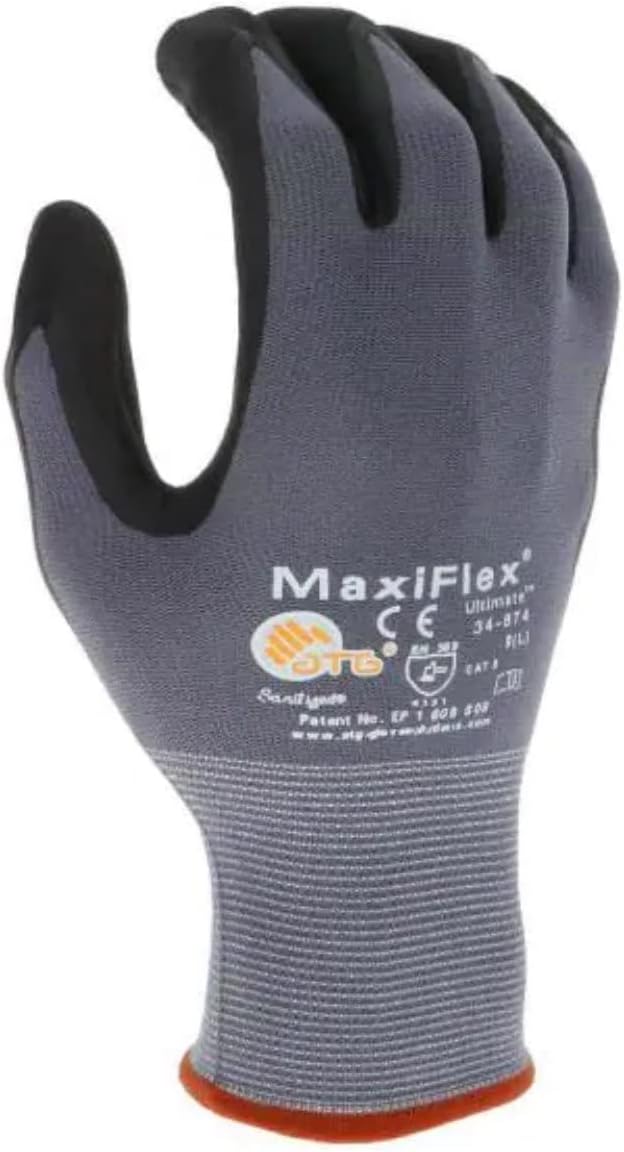
If you’ve ever grabbed a box of work gloves off a shelf because they looked tough, put them on, and then immediately struggled to pick up a small bolt or feel what your hand was doing — you’ve already experienced the core trade-off this article is about. Work gloves are designed to protect your hands from cuts, abrasion, and grip failures, but the coating that gives a glove its toughness also changes how much sensation and fine-motor control you keep. Nitrile is a synthetic rubber material applied to the palm, fingertips, or full hand of a glove’s liner; it grips wet or oily surfaces far better than bare fabric and resists punctures better than bare skin. The question isn’t whether nitrile coating is good — it is — but which nitrile application, in which thickness, over which liner, matches what your shop actually demands. This guide walks you through the ratings, the real-world feel differences, and the decision logic to get you to the right glove without buying three wrong ones first.
What ANSI/ISEA 105 Actually Tells You (and What It Doesn’t)
The label on most reputable work gloves will reference ANSI/ISEA 105-2016 — that’s the American National Standard for Hand Protection Selection Criteria, published jointly by the International Safety Equipment Association and the American National Standards Institute. In plain language, it’s the testing framework that assigns numeric performance levels to gloves across several hazard categories: cut resistance, puncture resistance, abrasion resistance, and a few chemical and thermal properties.
Here’s the critical piece most buyers miss: ANSI/ISEA 105 tests the complete glove assembly, not the coating in isolation. The cut resistance rating — expressed as A1 through A9, where A1 stops minimal force and A9 stops serious blade force — reflects the liner and coating working together. A foam nitrile coating over a high-performance polyethylene liner will score very differently than the same coating over a standard nylon shell.
The ratings you’ll see most often in a shop context:
| ANSI Cut Level | Approximate Force Threshold | Typical Application |
|---|---|---|
| A2 | 500–999 grams | Light assembly, general handling |
| A4 | 1,500–2,199 grams | Sheet metal, glass handling |
| A6 | 3,500–4,999 grams | Metal fabrication, stamping work |
| A9 | 6,000+ grams | Extreme cut hazards, wire handling |
The abrasion rating runs 1–6 (6 being best), and puncture resistance runs 1–4. For most shop work, you’re looking for at least an abrasion rating of 3 and a cut level of A2 at minimum — though cabinet makers handling hardware and auto-body techs working near sheet metal edges should be targeting A4 or higher, per guidance in Safety+Health Magazine’s glove selection resources.
What ANSI/ISEA 105 does not tell you: how the glove actually fits your hand, whether the coating cracks after 40 hours of use, or how much dexterity you’ll sacrifice. That’s where coating type and application method take over.
The Three Coating Configurations and What Each Trades Away
Nitrile shows up on gloves in three main formats, and each one lands differently in terms of grip, protection, and feel. Understanding the configuration is more useful than just reading the brand name.
Full-dip nitrile coats the entire glove — palm, back of hand, and fingers — in a uniform layer of rubber. This is the tank approach. Owners of full-dip gloves in aggregated reviews consistently describe maximum grip in wet or oily conditions and solid abrasion resistance, but they also note that the coating stiffens the glove overall, making fine grip tasks — threading a nut, handling small fasteners, reading a caliper — noticeably harder. Full-dip makes strong sense for concrete work, pipe fitting, or any application where your hands are frequently in contact with slick or sharp surfaces and precision manipulation isn’t the priority.
Palm-coated nitrile leaves the back of the hand uncoated (usually a breathable knit or engineered fabric) and coats only the palm and fingers. This is the most common configuration for general shop use, and for good reason: the back breathes, the palm grips, and the overall glove weight and stiffness stay lower. Per ISHN’s coverage of coating configurations, palm-dip formats offer a meaningful dexterity improvement over full-dip without sacrificing the grip performance most tradespeople actually need.
Foam nitrile coating is a palm- or fingertip-applied layer that’s been aerated during the manufacturing process, creating a slightly spongy, micro-textured surface. Foam nitrile is engineered specifically for dexterity-sensitive tasks: it channels liquids and fine particles away from the contact surface (improving wet grip) while keeping the coating thinner and more flexible than standard nitrile. If you’re doing finishing work — light sanding, staining, trim carpentry, automotive detailing — foam nitrile over a thin liner is where the dexterity-to-protection ratio peaks. The trade-off is durability: foam nitrile coatings abrade faster than solid nitrile under heavy mechanical stress.
A note worth making here: NIOSH’s hand protection resources emphasize that no single glove configuration is universally correct, and that task-by-task analysis is the appropriate selection method. That’s not bureaucratic hedging — it’s genuinely true in a shop context where you might go from ripping plywood to setting hinges in the same hour.
The Dexterity Trade-Off: Where the Math Gets Real
Let’s put some numbers on the dexterity question, because it’s the one most buyers underweight until they’re actually wearing the gloves.
By the numbers:
- Standard palm-dip nitrile over a 13-gauge nylon liner: typical coating thickness 0.8–1.2 mm, touch sensitivity rating (ANSI EN 388 tactile index) equivalent approximately 2/5
- Foam nitrile over a 15-gauge nylon liner: typical coating thickness 0.4–0.7 mm, tactile sensitivity closer to 3–4/5
- Full-dip nitrile over an engineered cut-resistant liner: coating thickness often 1.5–2.0 mm, tactile sensitivity approximately 1–2/5
Source: coating thickness ranges cited in ANSI/ISEA 105-2016 and manufacturer technical data sheets across major PPE categories.
The gauge of the liner matters as much as the coating. Higher gauge numbers mean finer, thinner knit — a 15-gauge liner is notably more dexterous than a 7-gauge liner even with identical coatings applied. This is why the KleenGuard G40 Foam Nitrile (a 15-gauge foam nitrile glove widely stocked through safety distributors) gets repeatedly cited in procurement circles as a benchmark for light-to-medium assembly work: the thin liner plus foam coating combination keeps tactile feedback high while meeting A2 cut and solid abrasion ratings.
For heavier cut environments — sheet metal fabrication, stamping, or working with hardware that has genuine edge hazards — you’re accepting the dexterity cost. An A6-rated glove with a HPPE (high-performance polyethylene) liner and palm-dip nitrile will feel meaningfully stiffer, but the protection delta at the A6 level over A2 is real and documented in ANSI/ISEA 105 cut-force testing. OSHA’s personal protective equipment publication (OSHA 3151) is explicit that under-protection is a greater incident risk than over-protection in cut hazard environments.
The practical decision frame: if your work requires you to pick up objects under 1 inch and feel what’s happening with your fingers — hardware installation, electrical rough-in, detailed assembly — start with foam nitrile on a 15-gauge liner and verify the ANSI cut level meets your actual hazard. If your work puts your hands near sheet metal edges, saw blades, or abrasive materials for sustained periods, accept the dexterity trade and move up the cut scale.
Fit, Sizing, and the Variables That Ratings Don’t Capture
No ANSI rating tells you whether a glove will actually stay on your hand correctly, and in practice, fit failures cause as many incidents as specification mismatches. A glove that bunches at the fingertips, gaps at the palm, or rides loose at the wrist creates a grip compensation problem — your hand tightens harder to make up for the poor fit, fatigue sets in faster, and fine-motor control degrades.
A few fit realities that come up consistently in shop and trade contexts:
Hand width versus hand length are both variables. Most glove sizing (S/M/L/XL or numeric sizing like 7–11) is keyed primarily to palm circumference. People with wide, short hands and people with narrow, long hands both end up in compromised fits from standard sizing. Several manufacturers — including Wells Lamont, Mechanix Wear, and Portwest — publish both circumference and length dimensions; cross-referencing both will improve fit outcomes significantly.
Coated gloves size down under use. Nitrile coatings, particularly full-dip configurations, tend to stretch slightly with wear and then relax. Owners of new full-dip gloves frequently report that a size that feels tight initially becomes a good working fit after a few hours of break-in. Starting one size down from your measured size is a documented workaround in Safety+Health Magazine’s fit guidance.
Cuff length matters for some tasks. Standard knit wrist cuffs are fine for general handling, but if your hands are frequently going into tight spaces or around machinery, a longer safety cuff or a gauntlet-style extension keeps the glove from pulling off the hand mid-task. This isn’t a premium feature — it’s a functional consideration that some mid-range gloves include and others don’t, regardless of price.
If X, Then Y: The Decision Rules
Here’s where the analysis collapses into actionable picks based on what your shop actually does.
If you’re doing general assembly, light hardware work, or repetitive handling of packaged or processed goods: Foam nitrile on a 15-gauge liner at ANSI A2 cut, abrasion level 3 or higher. The KleenGuard G40 Foam Nitrile is the reference point at the mid-market price range. You want dexterity and you’re not facing serious cut hazards — don’t sacrifice feel for protection you don’t need.
If you’re handling sheet metal, stamped parts, or construction materials with genuine edge exposure: Palm-dip nitrile over a HPPE or composite cut-resistant liner at ANSI A4 minimum, A6 if your hazard analysis supports it. Accept the tactile trade-off. Mechanix Wear CG Utility Gloves and Portwest A140 series are frequently cited benchmarks in this category.
If you’re doing detailed finishing work — automotive, cabinet installation, trim — where feel is paramount: Foam nitrile fingertip coating on a thin 15-gauge or finer liner. Some professionals in these trades go even thinner, toward a 18-gauge liner with nitrile dots rather than a full foam coating, which keeps ANSI ratings lower but maximizes tactile sensitivity for truly fine work. Understand the protection you’re giving up and make a deliberate call.
If you’re outfitting a crew and standardizing a single SKU: A palm-dip nitrile at A2–A4 on a 13-gauge liner is your best single-SKU compromise across task variety. It won’t be optimal for any one task, but it provides adequate protection and workable dexterity across a broad range of shop work. Run a separate SKU for any crew members with dedicated high-cut-hazard tasks.
The core principle that ANSI/ISEA 105 and OSHA’s PPE framework both point toward: the glove that actually gets worn is the glove that does its job. A worker who pulls off an A6 glove because it’s too stiff for the task they’re doing is more exposed than the worker in an A3 glove that stays on. Match the spec to the actual hazard, size for real fit, and revisit the selection when the task changes.