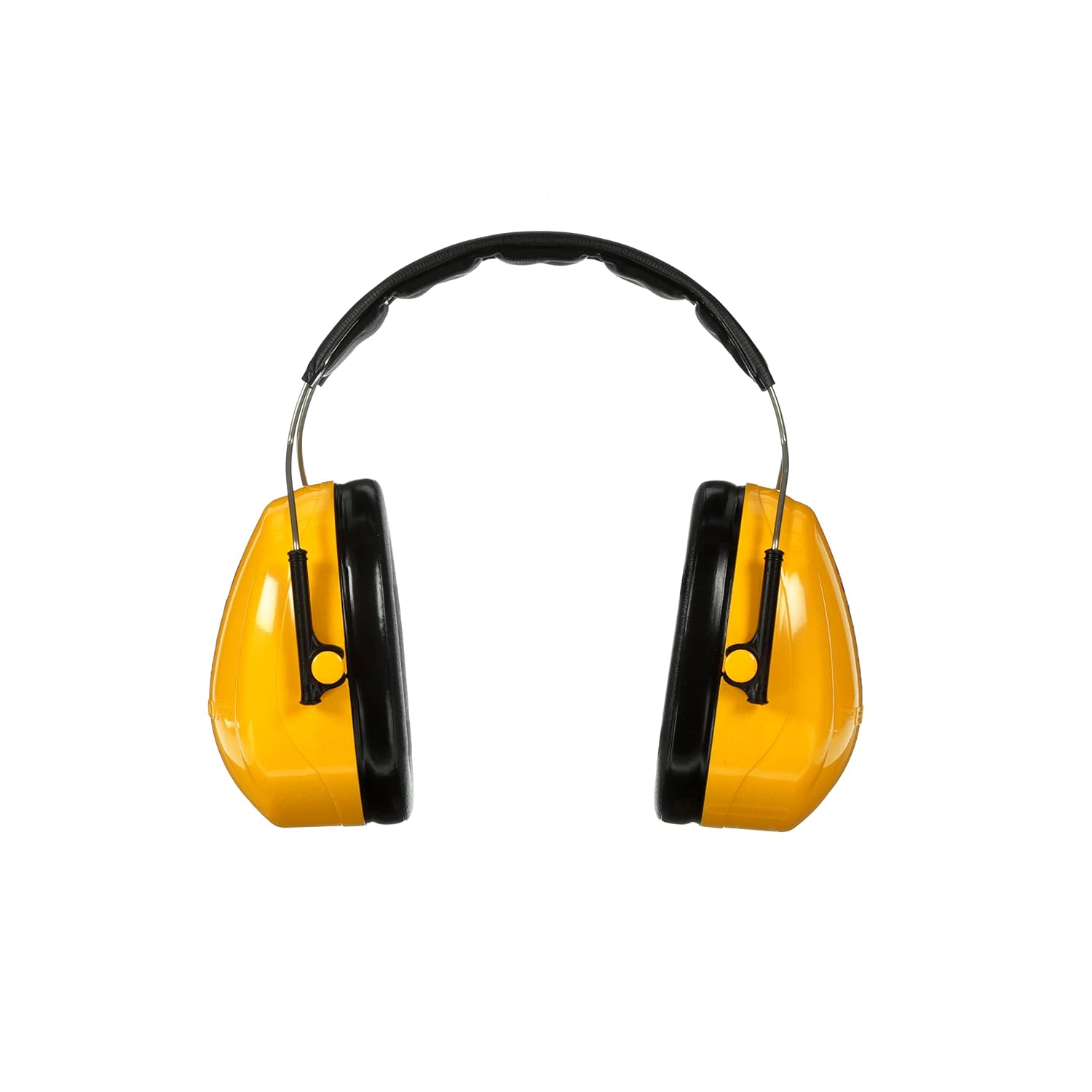
Noise-induced hearing loss is permanent — there’s no surgery or hearing aid that fully restores what’s gone, which makes the protection you wear today one of the highest-stakes gear decisions in any shop. The number you’ll see on every pair of earmuffs is called the NRR, which stands for Noise Reduction Rating — it’s a lab-measured score, expressed in decibels (dB), that tells you how much sound the device blocks under controlled test conditions. A higher NRR means more potential protection. Simple enough. The catch — and it’s a meaningful one — is that the NRR number on the package almost certainly overstates what you’ll actually get in the real world. Understanding why, and knowing how to correct for it, is the difference between choosing a product that genuinely protects your hearing and one that just feels like it does.
This guide is for the shop owner, tradesperson, or crew manager who’s already past “I need ear protection” and is now asking the sharper question: which rating, for which tool, for which work session? We’ll decode the NRR math, map it to real shop noise levels, and give you a clear decision frame across the 3M Peltor, MSA Sordin, Honeywell Howard Leight, and Moldex product families — from the practical NRR 22 range up to the NRR 37 ceiling you’ll find on category leaders.
Why the NRR Number Isn’t the Whole Story
The NRR is calculated under the ANSI/ASA S3.19 standard — a lab protocol that seats trained subjects in an acoustic chamber under optimal fitting conditions. Real-world fit, hair, eyeglasses temples, and inconsistent seal pressure all reduce effective attenuation. NIOSH, the National Institute for Occupational Safety and Health, is explicit about this in their noise exposure guidance: they recommend applying a 50% derating factor to the labeled NRR for earmuffs (and 70% for foam earplugs) to estimate realistic field performance.
Here’s the math you actually use:
Effective protection (dBA) = (NRR − 7) ÷ 2
So an earmuff rated NRR 30 gives you roughly 11.5 dB of real-world noise reduction, not 30. An NRR 22 earmuff delivers around 7.5 dB. That gap matters enormously when you’re running a router table at 100 dB or a cabinet shop spray booth with compressor noise layered underneath.
OSHA’s noise standard (29 CFR 1910.95) sets the permissible exposure limit at 90 dBA over an 8-hour day, with action level at 85 dBA — meaning hearing protection becomes mandatory above 85 dB for sustained work. Per ISHN’s earmuff selection guidance, the practical rule is: identify the loudest tool you use regularly, subtract your effective attenuation, and confirm you land below 85 dBA for the duration of exposure. Don’t model it for your quietest task. Model it for your worst one.
Mapping NRR Ranges to Real Shop Scenarios
Here’s where the rubber meets the road. Most shops run a mix of tools, and the right earmuff depends on peak noise, not average noise.
By the numbers — common shop noise levels:
| Tool / Environment | Approximate dBA |
|---|---|
| Orbital sander | 86–91 dB |
| Router table | 95–100 dB |
| Circular saw | 100–105 dB |
| Angle grinder | 100–106 dB |
| Pneumatic nailer | 108–110 dB (impulse) |
| Metal fabrication shop (ambient) | 95–105 dB |
| Auto body grinder + compressed air | 100–108 dB |
NRR 22–25 (effective ~7–9 dB field reduction) This is the practical floor for sustained shop work. Think: cabinet finishing with orbital sanders, light assembly, occasional circular saw cuts. The 3M Peltor H7A sits in this range and is widely used where workers need to communicate frequently — lower attenuation means easier conversation. Owners in aggregated reviews consistently note these are comfortable for all-day wear, and that’s the real advantage: a moderate-NRR muff that stays on beats a high-NRR muff that gets pulled off. The tradeoff is clear — don’t reach for NRR 22 if your work involves routers or grinders running continuously.
NRR 26–30 (effective ~9.5–11.5 dB field reduction) The workhorse zone for most serious shops. The 3M Peltor X3A (NRR 28) and Honeywell Howard Leight Sync series (NRR 25–30 depending on model) live here. The Peltor X-series uses a multi-shell cup design that spec sheets confirm provides better high-frequency attenuation than single-shell designs — relevant if you’re running high-pitched routers or spindle moulders. Owners report the X3A’s headband pressure is noticeably firmer than budget earmuffs, which trades some all-day comfort for a more consistent seal. For a shop running a mix of table saw, router, and sander work, this range is the rational center of gravity.
NRR 31–37 (effective ~12–15 dB field reduction) The high-protection tier. The 3M Peltor X5A (NRR 31) is the most widely specified earmuff in this category — safety directors at fabrication shops and metal shops consistently choose it for high-ambient environments. At the NRR 37 ceiling, the MSA Sordin Supreme Pro and Moldex 6505 are both cited in ISHN’s selection guides as appropriate for sustained exposure above 105 dB. One critical fit note from Safety+Health Magazine’s hearing protection coverage: at NRR 31+, cup depth and seal integrity become the dominant variable. Workers with facial hair or prominent eyeglass temples see the largest real-world attenuation drop in this tier — potentially losing 3–6 dB of effective protection just from an imperfect perimeter seal. That’s not a reason to avoid high-NRR muffs; it’s a reason to fit-check them with your actual glasses and face geometry before committing to a crew order.
The Glasses and Facial Hair Problem (and How to Address It)
This is the most consistently underestimated fit variable in hearing protection, and it costs people real attenuation every day. The earcup seal relies on continuous foam contact around the ear — any break in that seal is a direct acoustic leak.
Eyeglasses temples: Standard temples (the arms that run over your ears) break the earcup seal. The thicker the temple, the worse the leak. Per published manufacturer guidance from 3M’s hearing protection application notes, workers wearing glasses can lose 5–7 dB of effective attenuation from temple interference — in practical terms, that can cut your effective protection roughly in half for mid-frequency noise. Solutions: slim-temple safety glasses (Uvex Pheos CX2 and similar low-profile designs are frequently specified alongside high-NRR earmuffs for exactly this reason), or dielectric cable temples. Some workers use the foam-and-glasses combination — a fitted earplug under the earcup — when maximum protection is needed and glasses can’t be swapped.
Facial hair: Stubble and full beards both reduce earcup seal quality. NIOSH’s noise control engineering guidance explicitly notes that half-mask respirators and earmuffs share this problem — any surface that interrupts the perimeter seal reduces protection. For workers with beards, the practical guidance is: choose earmuffs with a deeper, softer foam cushion (the 3M Peltor X5A uses a larger-diameter cup for this reason), and accept that real-world attenuation may be 20–30% lower than labeled NRR. If your noise exposure is at the top of the range, that margin disappears fast — consider double protection (earplugs + earmuffs) for sustained high-decibel sessions.
Head size and headband pressure: Brands vary significantly. MSA V-Gard cap-mounted earmuffs and the Sordin series are frequently cited by operators as better-fitting for larger head circumferences than the Peltor X-series. If you’re outfitting a crew, ordering a sample before a bulk buy isn’t optional — it’s basic due diligence.
Practical Decision Frame: If X, Then Y
Here’s the decision matrix that should drive your purchase:
If your loudest regular tool tops out at 90–95 dB (sander, jigsaw, light assembly): NRR 25–28 is appropriate. The 3M Peltor X2A or Howard Leight Sync series delivers adequate protection with better all-day wearability. Don’t over-protect for tasks that don’t demand it — comfort compliance matters.
If you run routers, table saws, or circular saws regularly (95–105 dB range): Step to NRR 28–31. The 3M Peltor X3A or X5A is the standard recommendation. If you wear glasses, prioritize fit over raw NRR — an NRR 28 muff with a clean seal beats an NRR 31 muff with a leaky one.
If you’re in a fabrication shop, auto body environment, or running grinders and pneumatic tools (100–110 dB sustained): NRR 31+ is the correct specification, not a “nice to have.” The 3M Peltor X5A is the most specified product in this range. For impulse noise (nail guns, powder-actuated tools), consider the Moldex 6505 or MSA Sordin series — both carry strong operator reviews for impulse noise handling.
If you’re outfitting a five-person crew across mixed tasks: Standardize on NRR 28–31 and document it. The OSHA 1910.95 standard requires employers to evaluate the adequacy of hearing protectors annually — having a documented specification with NRR and derating calculations on file is not bureaucratic overhead, it’s liability management. Safety+Health Magazine’s coverage of OSHA hearing conservation program audits consistently highlights inadequate protector selection as one of the top cited deficiencies.
If communications matter (site coordinator, crew lead, equipment operator): Consider communication-enabled earmuffs — the 3M Peltor WS Workitout and MSA Sordin Supreme Pro-X are both Bluetooth-enabled with published NRR ratings in the 24–31 range. The attenuation tradeoff is real but manageable; the compliance benefit of workers actually keeping them on is worth it.
The Bottom Line on NRR Math
Hearing protection is one of the few PPE categories where the product literally does less than advertised — not because manufacturers are deceptive, but because the lab standard doesn’t replicate field conditions. Per CDC/NIOSH noise exposure guidance, the derating calculation is not optional if you’re making serious decisions: take the labeled NRR, subtract 7, divide by 2, and that’s your working number.
For most workshop environments, an NRR 25–31 earmuff, properly fitted to your face geometry, with your actual glasses and beard situation accounted for, is where you’ll find the performance you need. Spend the extra ten minutes fit-checking before you buy a case. Hearing damage doesn’t announce itself until it’s already done.