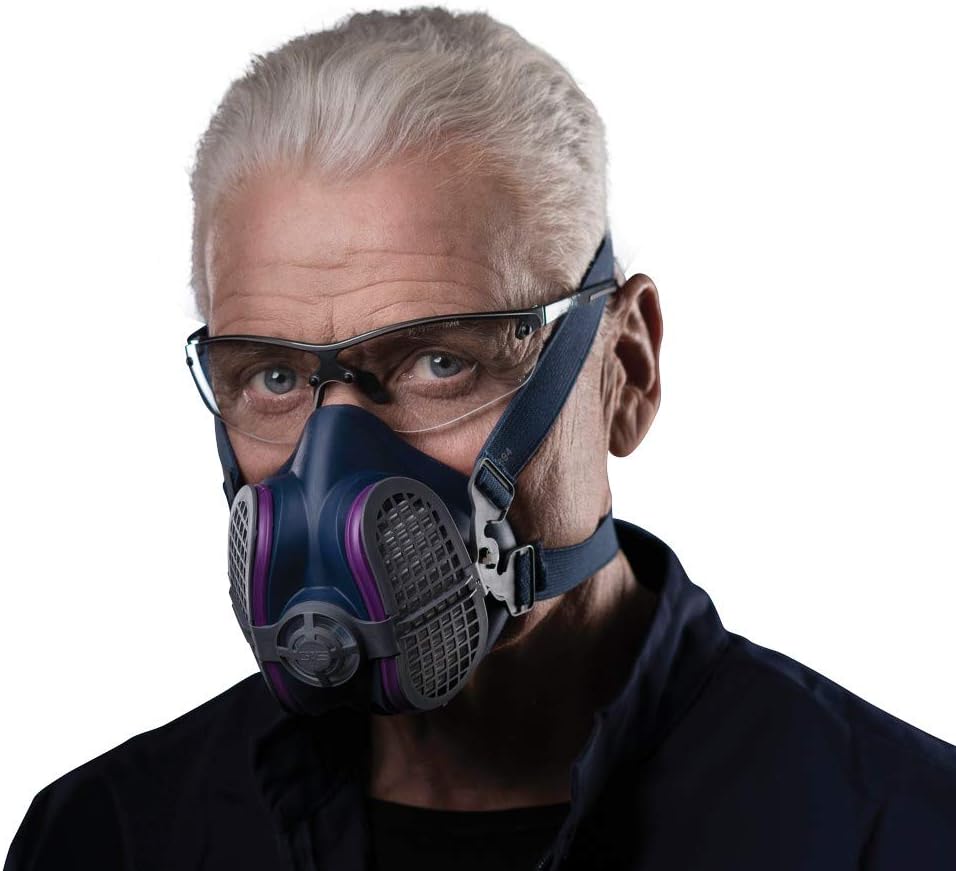
If you spend more than an hour at a time spraying lacquer, applying auto-body primer, or sanding pre-finished hardwood, you already know that a cheap dust mask isn’t enough — and you probably know you need a half-mask respirator. A half-mask respirator is a reusable rubber or silicone facepiece that covers your nose and mouth (not your eyes), seals against your face with a pair of straps, and accepts replaceable filter cartridges matched to your specific hazard — whether that’s organic vapors from solvent-based finishes, fine particulate from sanding, or both at once. Unlike a disposable filtering facepiece (the N95-style masks most people recognize), a half-mask is designed for daily professional use: you swap the cartridges, clean the facepiece, and keep going.
The question this guide answers isn’t whether you need one — you do. The question is which one actually stays comfortable across a four-hour cabinet finishing session or a full spray day in the body shop. Two models dominate that conversation at the professional tier: the 3M 6500 Series and the Honeywell North 7700 Series. Both are NIOSH-approved, both accept a wide cartridge ecosystem, and both sit in a price range — roughly $25–$55 for the facepiece alone — where the decision deserves more than a coin flip. Here’s the spec-grounded breakdown.
| EDITOR'S PICK[GVS SPR457 Elipse P100 Dust Hal…](https://www.amazon.com/dp/B0F4RKW11X?tag=greenflower20-20) | Mid-tierNORTH Honeywell Home North 7700… | Budget pick3M Half Facepiece Reusable Resp… | |
|---|---|---|---|
| Filter type | P100 | — | — |
| Material | — | Silicone | — |
| Reusable filters | ✓ | — | — |
| NIOSH approved | — | ✓ | ✓ |
| Size | M/L | Large | Large |
| Price | $55.46 | $35.50 | $21.99 |
| See on Amazon → | See on Amazon → | See on Amazon → |
What NIOSH Approval Actually Means (and Why It’s the Floor, Not the Ceiling)
Before comparing the two masks, it’s worth decoding the standard they both meet. NIOSH — the National Institute for Occupational Safety and Health, operating under the Centers for Disease Control and Prevention — approves half-masks under 42 CFR Part 84, the federal regulation that sets minimum performance requirements for air-purifying respirators. A NIOSH approval number on the facepiece (look for “TC-23C” for half-masks) means the mask has passed fit, filtration, and construction tests under controlled lab conditions. The NIOSH National Personal Protective Technology Laboratory maintains a publicly searchable Trusted-Source respirator database where you can confirm a specific model’s current approval status by manufacturer name and approval number.
That approval is the floor. It tells you the mask can seal and protect; it doesn’t tell you it will seal on your face across your workday. Per OSHA’s Respiratory Protection Standard, 29 CFR 1910.134, any worker using a tight-fitting respirator in a regulated environment must undergo a fit test — a standardized protocol that confirms the specific facepiece achieves a proper seal on that individual’s face shape. The American National Standards Institute’s ANSI/ISEA Z88.2-2015, American National Standard for Respiratory Protection, reinforces this: fit variability between brands and sizes is real and significant, and no single facepiece geometry fits all users.
The practical takeaway: NIOSH approval is a necessary condition for both masks, but fit testing — and honest attention to your facial geometry — is what separates “technically compliant” from “actually protective all day.”
Head-to-Head: Three Dimensions That Decide Long-Session Fit
H3: Facepiece Material and Seal Conformability
The most consequential engineering difference between these two respirators is the material each manufacturer chose for the facepiece itself.
The 3M 6500 Series facepiece is constructed from a soft thermoplastic elastomer. 3M’s published technical documentation for the 6500 Series describes a cradle suspension system that distributes strap tension across four contact points rather than two, reducing pressure-point fatigue during extended wear. The facepiece geometry is designed to seat against the face at a relatively flat profile, which works well for average to narrower face shapes and tends to clear full-frame safety glasses without breaking the seal at the cheek junction. The cartridges mount at an outward angle rather than projecting straight forward, which reduces interference when working close to a spray booth window or a welding shield.
 product image](/images/external/32a58a6ecbee.jpg)
NORTH 770030L
$35.50
In stock on Amazon
Check price on AmazonThe Honeywell North 7700 Series leads with liquid silicone rubber as its facepiece material. Honeywell’s published product documentation describes the 7700’s facepiece as designed to conform to individual facial contours during wear — a material property that translates, in practice, to meaningfully better seal performance for users with wider face shapes, more prominent cheekbones, or facial structures that tend to create leak paths with flatter-profile facepieces. Safety+Health Magazine, published by the National Safety Council, has noted in its coverage of half-mask respirator selection that softer, more conforming facepiece materials consistently produce better fit-test outcomes for users with wider or more angular facial geometry. Silicone is also more resistant to chemical degradation from solvents than most thermoplastic materials, which extends facepiece service life in finishing environments where wiping down with acetone or lacquer thinner is routine.
GVS
$55.46
In stock on Amazon
Check price on AmazonThe tradeoff: silicone attracts airborne paint overspray and fine dust more readily than the harder thermoplastic surface of the 6500. Cleaning the 7700 facepiece after a spray session requires more deliberate attention — a wipe-down, not a quick rinse. Some operators also find the 7700 feels slightly heavier when holding it before donning, though in practice the difference during wear is minimal.
NORTH 770030L
$35.50
In stock on Amazon
Check price on AmazonH3: Exhalation Valve and Thermal Comfort
This is where environment becomes the deciding variable, and it’s one that finishing professionals often underweight until they’ve pulled a mask down at the two-hour mark because the heat became intolerable.
The 3M 6500 Series incorporates 3M’s proprietary Cool Flow exhalation valve — a one-way valve designed to vent exhaled air downward and away from the face rather than allowing it to pool inside the facepiece. In aggregated professional reviews and in coverage by ISHN (Industrial Safety & Hygiene News), the Cool Flow valve is consistently cited as the 6500’s most significant comfort advantage over both its predecessor (the 3M 6000 Series) and competing designs. In warm or humid conditions — a body shop in July, a spray booth where ambient temperature climbs during a full production day — directional venting has a measurable effect on how long a respirator stays on. ISHN’s coverage of respirator comfort factors has specifically identified heat buildup and breathing resistance as the two leading causes of workers removing tight-fitting respirators mid-task, which eliminates all protection regardless of the mask’s technical specification. A mask that stays on is always safer than a technically superior mask that comes off.
NORTH 770030L
$35.50
In stock on Amazon
Check price on AmazonThe Honeywell North 7700 Series uses a standard low-profile exhalation valve without directional venting. In a climate-controlled shop or in cooler ambient conditions, this is a non-issue — the valve functions correctly and breathing resistance is comparable to the 6500. In warm or humid conditions, some operators report slightly more heat buildup than with the Cool Flow design. This is not a defect in the 7700; it’s a design tradeoff that favors simplicity and seal reliability over active thermal management.
GVS
$55.46
In stock on Amazon
Check price on AmazonH3: Cartridge Ecosystem and Maintenance Cost
Both masks accept a mature ecosystem of replacement cartridges, but the cartridge architecture differs in ways that affect per-session cost and setup complexity.
The 3M 6500 Series uses 3M’s 60-Series bayonet-mount cartridges. For finishing work, the standard combination setup is the 3M 6001 organic vapor cartridge paired with a 3M 5N11 particulate pre-filter and a 501 filter retainer — three components per side. This modular approach lets you swap only the component that’s spent: if your OV cartridges are exhausted but the pre-filters are still within service life, you replace cartridges without discarding the filters. Replacement 6001 OV cartridges run approximately $12–$18 per pair at safety distributor pricing; pre-filters add a few dollars per pair. The 3M cartridge ecosystem is among the most widely distributed in North America, available through virtually every safety supply channel.
NORTH 770030L
$35.50
In stock on Amazon
Check price on AmazonThe Honeywell North 7700 Series uses North-format bayonet cartridges. For organic vapor plus particulate protection in a finishing environment, the North 7583 P100/OV combination cartridge consolidates HEPA-level particulate filtration and organic vapor absorption into a single cartridge body — eliminating the need for a separate pre-filter and retainer. This simplifies setup and reduces the number of components to track and replace. Replacement 7583 combination cartridges run approximately $18–$28 per pair, slightly higher than the equivalent 3M modular setup, but the consolidated design removes an accessory purchase. Honeywell North cartridges are widely available through safety distributors, though in some regional markets the 3M ecosystem has a distribution depth advantage.
GVS
$55.46
In stock on Amazon
Check price on AmazonBy the Numbers
| Feature | 3M 6500 Series | Honeywell North 7700 |
|---|---|---|
| Facepiece material | Thermoplastic elastomer | Liquid silicone rubber |
| Sizes available | S / M / L | S / M / L |
| Exhalation valve | Cool Flow directional | Standard low-profile |
| Cartridge mount | 3M 60-Series bayonet | North bayonet |
| Facepiece street price (mid-2026) | ~$25–$35 | ~$30–$45 |
| OV + P100 cartridge price/pair | ~$15–$22 (modular components) | ~$18–$28 (single combo cartridge) |
| Best-fit face profile | Average to narrower | Wider, more prominent cheekbones |
Fit Variables That Matter More Than Brand Preference
Both masks are well-engineered products that pass the same federal approval standard. The variable that determines which one actually protects you — and which one you tolerate for four hours — is your face geometry and your working conditions.
Glasses compatibility: Both masks seal below the eye socket, so safety glasses should not break the seal when worn correctly. The 6500’s flatter cheek profile is more consistently reported as compatible with full-frame safety glasses. If you wear prescription safety glasses with wide temples, the 6500 warrants first consideration.
Facial hair: Neither mask seals over anything beyond light stubble along the seal line. OSHA’s Respiratory Protection Standard, 29 CFR 1910.134, is explicit: facial hair that lies along the sealing surface of a tight-fitting facepiece invalidates the fit and the protection. This isn’t a brand variable — it’s physics and federal regulation. If a beard is non-negotiable, a loose-fitting powered air-purifying respirator (PAPR) is the correct solution, not a half-mask in any brand.
Crew outfitting: If you’re equipping five or more workers, run quantitative fit tests before issuing masks. OSHA 1910.134 requires quantitative fit testing for IDLH environments; Safety+Health Magazine and ISHN both recommend it as best practice for any professional shop regardless of regulatory threshold. The ANSI/ISEA Z88.2-2015 standard is explicit that no single facepiece geometry fits all face shapes. Stock both models in multiple sizes and let fit-test results — not purchasing convenience — determine which mask goes to which worker. A failed fit test discovered before a worker enters a spray booth costs nothing. A workers’ comp event costs considerably more.
The Decision Rule
The tradeoffs are real, but the decision framework is clean:
- If you run long sessions in warm or humid conditions, wear full-frame safety glasses, and have an average or narrower face profile → the 3M 6500 Series is the stronger call. The Cool Flow valve and low-profile cartridge geometry are built for exactly this use case, and the modular cartridge ecosystem is available through virtually every safety supply channel.
NORTH 770030L
$35.50
In stock on Amazon
Check price on Amazon- If you’ve had seal problems with other half-masks, have a wider or more prominent facial structure, or want a simplified single-cartridge setup that eliminates pre-filter components → the Honeywell North 7700 is the stronger call. The silicone facepiece’s conformability addresses the most common reason finishers abandon half-masks after a few sessions, and the North 7583 combination cartridge simplifies maintenance.
GVS
$55.46
In stock on Amazon
Check price on Amazon- If you’re outfitting a crew, stock both models, run fit tests as required under OSHA 1910.134, and let results guide assignment. No single facepiece fits all face shapes — this is not a marketing caveat, it is the conclusion of the ANSI/ISEA Z88.2-2015 standard and the reason fit testing exists as a regulatory requirement.
Neither mask is the universal winner. Both earn their place in a serious finishing operation. The only performance metric that matters in practice is which one seals on your face and stays on through your full session. Verify current NIOSH approval status for any respirator using the NIOSH National Personal Protective Technology Laboratory’s Trusted-Source database before purchase.
All prices reflect mid-2026 distributor pricing for single-unit purchases. Cartridge prices vary by type and quantity. Combination cartridge pricing may differ from component pricing when purchased separately.