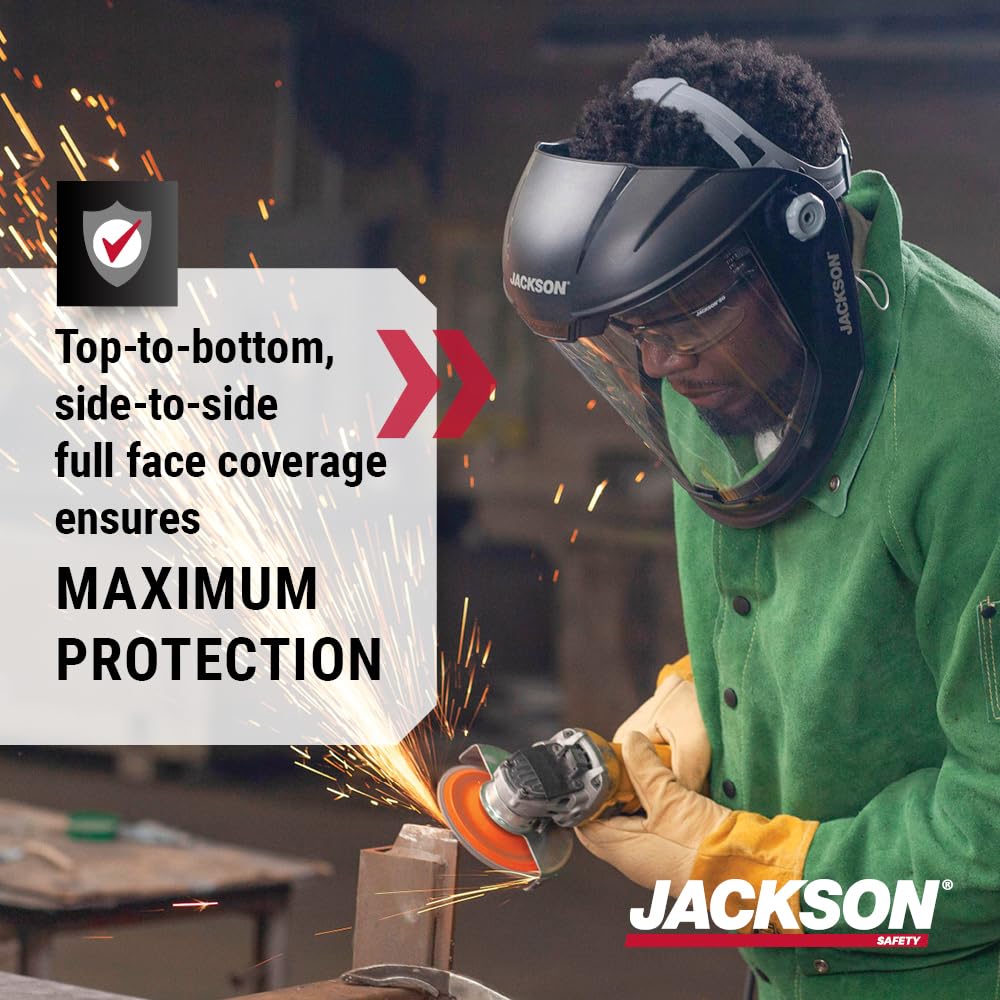
A face shield is the polycarbonate (a tough, clear plastic) visor worn over your entire face to block debris, sparks, and splatter. When you’re grinding metal or cutting tile, the hazard isn’t just a stray chip — it’s a fragment launched at speeds that can exceed 150–200 mph. The right shield stops that. The wrong one shatters, or worse, lets the fragment pass through at the edge. If you’ve ever shopped for a face shield and noticed some products say “Z87.1” and others say nothing at all, that certification gap is exactly what this article untangles. By the end, you’ll know what the Z87.1 standard actually requires, why the ratchet headgear suspension — the mechanism that tightens the shield against your head — matters as much as the lens itself, and which shields are worth the spend for serious grinding and cutting work.
What ANSI Z87.1 Actually Requires (And What It Doesn’t)
ANSI Z87.1-2020 is the benchmark standard published by the American National Standards Institute in partnership with the International Safety Equipment Association. It defines minimum performance requirements for eye and face protection in occupational and educational settings — think of it as the rulebook every legitimate safety-rated product must pass before it earns the marking. OSHA Standard 1910.133 makes compliance with this standard mandatory for most workplace eye and face protection decisions.
Here’s where practitioners get tripped up: Z87.1 uses a tiered marking system, and face shields span two distinct categories.
Z87.1 (basic impact) — The visor must stop a 1-inch steel ball dropped from 50 inches. That’s enough for splash protection and light debris. It’s the floor, not the ceiling.
Z87.1+ (high-impact) — The visor must survive a 1/4-inch steel ball fired at 150 feet per second at nine specific points on the lens. Per the ANSI/ISEA Z87.1-2020 document, the ”+” marking is the differentiator between a splash guard and a fragment barrier. For grinding — angle grinders, cut-off wheels, bench grinders — Z87.1+ is the minimum acceptable rating. Full stop.
A face shield marked only “Z87” without the ”+” is not rated for high-velocity impact from abrasive operations. You’ll see plenty of them at box stores, often under $20. They’re fine for light chemical splash or woodworking chip protection. They are not appropriate when a 4-inch grinding disc is spinning at 11,000 RPM two feet from your face.
The lens thickness reality: NIOSH’s Eye and Face Protection eTool notes that polycarbonate visors rated for high-impact grinding typically run 2.0 mm to 3.0 mm in thickness. Thinner materials may pass basic Z87.1 drop tests but fail under the high-velocity projectile requirements of Z87.1+. Published spec sheets from major manufacturers confirm this pattern — Uvex, Honeywell, and MSA all publish visor thickness alongside their Z87.1+ certifications.
Ratchet Headgear: The Part That Gets Ignored Until It Fails
Most buyers spend 90% of their evaluation time on the visor and 10% on the headgear suspension — the plastic or nylon harness that holds the shield on your head and positions it correctly over your face. That ratio should be closer to 50/50.
Here’s why: A Z87.1+ visor is only as protective as its fit at the moment of impact. If the shield has ridden up on your head, if the headband has slipped because a slip-ratchet mechanism has worn out, or if the pivot points have loosened so the visor is angled away from your face, the protection geometry is broken. The shield can deflect away from your face on impact rather than absorbing it.
Slip-ratchet vs. pin-and-slot headgear. Budget face shields use a pin-and-slot adjustment — you press a button, slide the band, release. It works initially, but the slots wear out, and the mechanism can release under the vibration of extended grinding sessions. Ratchet headgear uses a toothed dial (usually at the rear of the headband) that locks in fine increments and holds under load. Owners across long-session reviews consistently note that ratchet mechanisms maintain their set position through a full day of intermittent grinding where pin-slot versions drift noticeably.
The 4-point vs. 6-point suspension question. A 4-point suspension (four contact zones around the crown) distributes shield weight adequately for occasional use. For heavy shield configurations — say, a welding-shade visor or a deep-profile grinding shield worn for two-plus hours — a 6-point suspension distributes load more evenly and reduces the neck fatigue that causes operators to remove protection prematurely. Safety+Health Magazine’s face shield selection guidance specifically calls out extended-wear fatigue as a leading reason workers doff (remove) face protection before the task is finished.
Compatibility with hard hats. Many ratchet headgear systems are designed to slot into a Type I or Type II hard hat’s accessory rails (the side slots built into most compliant hard hats). If your crew wears MSA V-Gard or Honeywell Fibre-Metal hard hats on site, verify that the face shield’s headgear uses the same rail standard — most US-spec shields use a common 4-slot attachment, but metric-specification European imports sometimes diverge. The MSA V-Gard and its face shield accessories use an integrated ratchet that mounts directly to the hat; standalone shields from Uvex use a separate headband. Neither is wrong — just confirm before ordering across a crew.
By the Numbers
| Shield Class | Impact Rating | Typical Visor Thickness | Appropriate For |
|---|---|---|---|
| Basic (Z87.1) | 1-in. ball drop test | 1.0–1.5 mm | Chemical splash, light chips |
| High-Impact (Z87.1+) | 1/4-in. ball at 150 fps | 2.0–3.0 mm | Grinding, cutting, abrasive ops |
| Welding-shade (W scale) | Z87.1+ plus IR filter | 2.0–3.0 mm + coating | Torch cutting, plasma, MIG prep |
Source: ANSI/ISEA Z87.1-2020 published performance criteria.
Matching the Shield to the Specific Operation
Not all cutting and grinding hazards are identical, and the best intermediate-practitioner decision is the one that accounts for the specific threat profile — not just “I need a face shield.”
Angle grinder and cut-off wheel work. This is the highest-velocity fragment hazard in most shops. You want Z87.1+ rated, minimum 2.0 mm polycarbonate, full-coverage visor (chin-to-brow, ear-to-ear wrap). The ISHN published guidance on impact ratings notes that angle grinder disc failure — which can occur from a cracked or improperly mounted wheel — generates fragments with significantly higher kinetic energy than normal grinding sparks. A deep-profile visor (one that curves inward near the chin) reduces the gap between the bottom of the shield and your throat.
Bench grinder and pedestal grinder. Same Z87.1+ requirement. Because you’re stationary and the sparks travel in a predictable arc downward, some operators use the integrated eye shields on the grinder itself as their primary protection — that’s an OSHA 1910.133 compliance problem waiting to happen. The machine guard is a secondary barrier, not a replacement for face-level PPE.
Tile saw and masonry cutting. Silica dust (fine particles from cut concrete, brick, or tile that can cause serious lung disease over time) is the primary respiratory hazard here, but the cutting also throws fragment chips and water slurry into the face. A Z87.1+ shield paired with a properly fitted N95 respirator rated by NIOSH — the National Institute for Occupational Safety and Health, which approves respirators by testing filtration efficiency — covers both threat classes. The shield keeps chips and slurry off your face; the respirator handles the particles too small to see.
Plasma cutting and torch work. Standard polycarbonate visors are not rated for the infrared (IR) and ultraviolet (UV) radiation from plasma arcs. You need a visor with a welding shade rating — expressed as a “W” shade number (W3 through W8 for most torch and plasma applications) in the Z87.1 marking system. Using an unshaded Z87.1+ visor on a plasma cutter won’t cause immediate impact failure, but operators consistently report photokeratitis (a sunburn of the eye surface) from unfiltered arc exposure. This is the one context where the standard’s “W” designation matters as much as the ”+” marking.
The Tradeoff Map: Where to Spend and Where to Hold Back
The $15–$35 range covers basic Z87.1+ polycarbonate shields with pin-slot headgear. Brands like Sellstrom and Pyramex publish Z87.1+ specs at this price point. These are defensible for occasional use, single-operator shops, or backup shields. Owners note that headgear durability is the limiting factor — the visor often outlasts the headband.
The $40–$75 range is where ratchet headgear becomes standard and visor quality steps up meaningfully. Uvex’s Bionic Face Shield and Honeywell Fibre-Metal Peerless series both publish Z87.1+ ratings with ratchet mechanisms in this band. Published specs show anti-fog coatings and scratch-resistant treatments at this tier that are absent from budget options. For any operator doing more than an hour of grinding per week, the cost-per-use math strongly favors this range — a $60 shield used three times per week for two years works out to roughly $0.19 per session.
The $80–$150+ range covers hard-hat-integrated systems, specialty shade visors, and professional-grade suspensions designed for all-day wear. MSA’s full-brow hard hat shields, Fibre-Metal’s Series 280 system, and Kimberly-Clark Jackson Safety units with SureWerx headgear all operate here. For fabrication shops, auto-body operations, and construction sites where face protection goes on at 7 AM and comes off at 3 PM, this is the range that keeps protection on faces instead of hanging on a hook.
The Decision Rule
If you’re grinding or cutting more than occasionally in a professional or serious DIY context, here’s the if-then framework:
- If you’re doing intermittent hobby-level grinding (once a week or less): a Z87.1+-marked shield in the $30–$50 range with ratchet headgear is sufficient. Prioritize the ”+” rating over brand name.
- If you’re grinding or cutting daily, or outfitting a crew: move to the $60–$80 range with ratchet headgear, anti-fog coating, and confirmed hard-hat compatibility if head protection is also required. Don’t compromise on the ratchet — pin-slot headgear fails predictably under sustained use.
- If you’re doing plasma cutting, torch work, or extended MIG prep: add the W-rated visor shade appropriate to your process. A Z87.1+ shield without IR/UV filtering is incomplete protection for arc-adjacent work.
- If your work involves masonry or tile cutting**: pair the Z87.1+ shield with a NIOSH-approved respirator (N95 minimum). The shield doesn’t handle what you can’t see.
The Z87.1+ marking and a properly adjusted ratchet suspension are the two variables that separate a face shield from a face shield that actually works. Everything else — coatings, shade ratings, brand preference — is a refinement on top of that foundation. Get the foundation right first.