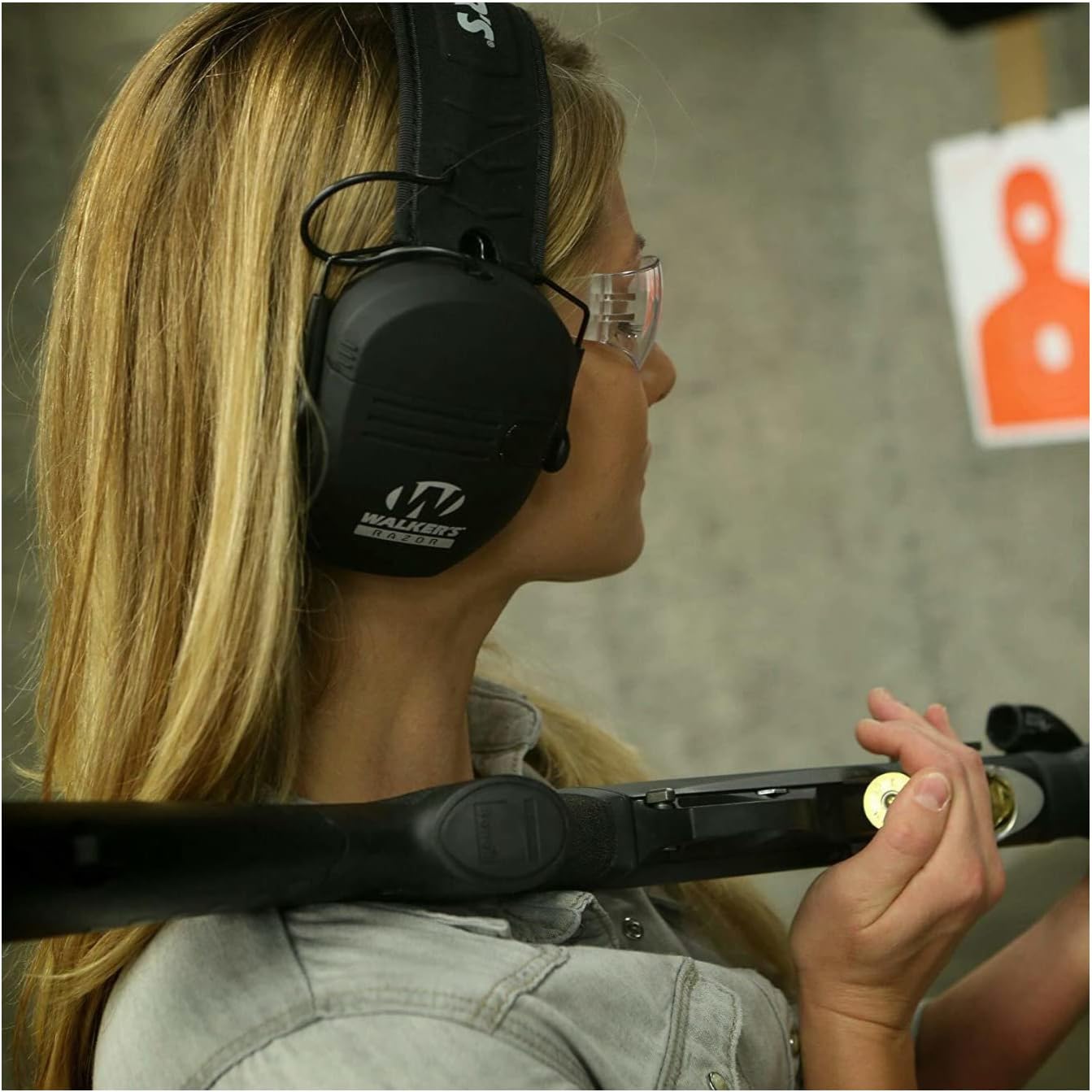
If you’ve ever yanked off your earmuffs just to hear a coworker say “hand me that wrench” — and then forgotten to put them back on for three minutes while the table saw was running — you already understand the core problem electronic earmuffs solve. Standard passive earmuffs (the foam-cushioned cups that simply block sound) are excellent at one job: making everything quieter. But in a busy shop, “everything quieter” includes your spotter calling out a measurement, a warning shout from across the floor, or the subtle change in a router’s tone that tells you something’s wrong. Electronic earmuffs use a tiny microphone-and-speaker system to let safe sounds through while still cutting dangerous noise peaks — so you stay protected without going into sensory isolation. This guide breaks down how to read the ratings that matter, what “ambient sound amplification” actually means in practice, and when the Bluetooth-equipped premium models earn their price tag versus when you’re just paying for a feature you’ll use twice.
Understanding NRR — and Why the Lab Number Isn’t the Whole Story
NRR stands for Noise Reduction Rating — it’s a single number, measured in decibels (dB), that appears on every hearing protector sold in the United States. The rating is established under ANSI S12.6, the American National Standards Institute’s standard for measuring how much a hearing protector reduces sound in a controlled lab environment with trained, motivated subjects fitting the device correctly. A higher NRR means more attenuation under ideal conditions.
Here’s the catch: NIOSH — the National Institute for Occupational Safety and Health — has long published guidance (in their document “Preventing Occupational Hearing Loss: A Practical Guide”) recommending that real-world users apply a derating factor to the labeled NRR. For earmuffs, NIOSH recommends dividing the NRR by 2 before subtracting from your ambient noise level, to account for imperfect fit and normal wear conditions. An earmuff rated NRR 31 dB, for example, delivers closer to 15–16 dB of practical protection in the average shop environment.
By the numbers — practical attenuation from rated NRR (NIOSH derating method):
| Labeled NRR | NIOSH Real-World Estimate | Effective Exposure at 100 dB |
|---|---|---|
| NRR 22 | ~11 dB | ~89 dB |
| NRR 26 | ~13 dB | ~87 dB |
| NRR 31 | ~15–16 dB | ~84–85 dB |
| NRR 37 | ~18–19 dB | ~81–82 dB |
OSHA’s noise standard (29 CFR 1910.95) sets permissible exposure at 90 dB averaged over an eight-hour workday — which means a grinder running at 100 dB needs real, consistent attenuation to keep you in safe territory across a long session.
For electronic earmuffs specifically, the NRR applies to the passive attenuation of the cups themselves when the electronics either shut down at loud peaks or are switched off. Most quality electronic earmuffs in the $50–$200 range carry NRR ratings between 22 and 31 dB. The electronics don’t add to attenuation — they manage which sounds pass through the speakers at reduced, safe levels. Understanding that distinction is the first decision-frame for this category.
How Ambient Sound Amplification Actually Works (and Where It Can Mislead You)
The phrase “ambient sound amplification” sounds reassuring — almost too good. Let’s decode it honestly.
An electronic earmuff’s microphone picks up external sound continuously. A circuit then processes that signal and routes it to a small speaker inside the cup. For everyday sounds — conversation, machine idle, a measurement being called out — the electronics pass the amplified signal through at a comfortable volume, often set to 82 dB maximum output regardless of input level. When the input noise spikes above a threshold (typically 82–85 dB, depending on the model), the circuit compresses or clips the signal nearly instantaneously — rated response times are typically under 2 milliseconds on quality units. During that clipping event, the passive cups take over, and your ears are protected by the physical shell alone.
This is the system working correctly. But there are real limitations worth knowing:
Compression timing matters more than most buyers realize. Impulse noise — a nail gun, a powder-actuated fastener, a gunshot — rises from ambient to dangerous in under 1 millisecond. Premium units from 3M Peltor and Howard Leight (Honeywell) publish attack times at or below 2 ms; budget units can lag at 5–10 ms. Across aggregated reviews and published specification comparisons, this timing gap is where the meaningful performance delta between a $40 unit and a $150 unit shows up most clearly in real use cases involving repeated impulse noise.
Microphone placement and directionality affect spatial awareness. Higher-end models — the 3M Peltor WS ALERT XP and the MSA Sordin Supreme Pro series, for instance — use dual microphones positioned to mimic the natural spatial separation of your ears. Budget single-mic designs compress everything into a flat mono signal. Operators in long-run reviews consistently report that the dual-mic designs let them localize sounds — knowing where a noise is coming from — in ways that single-mic versions don’t replicate.
Amplification doesn’t mean unlimited clarity. Most electronic earmuffs amplify ambient sound 4–8× to overcome the passive attenuation of the cups. In a quiet shop during startup, this can make normal conversation sound unnaturally loud or introduce audible hiss. This is a known tradeoff rather than a defect — Safety+Health Magazine has noted in coverage of electronic hearing protection adoption that hiss at low ambient volumes is one of the most frequently cited complaints in user feedback, particularly on lower-cost units.
Where Bluetooth Earns Its Price — and Where It Doesn’t
This is the question that drives most of the buying decisions in this category, so let’s put decision criteria directly on the table.
The case for Bluetooth: If you’re doing work that requires you to hear music, take calls, or monitor audio cues (safety alerts, timer pings, instructions relayed from a site coordinator) while working in sustained elevated noise — a table saw running repeatedly, extended router work, angle grinder finishing passes — Bluetooth integration removes the impossible choice between staying wired to a device and staying protected. Bluetooth-equipped models like the 3M Peltor LiteCom Pro III, the Howard Leight Sync Wireless, and the DeWalt Bluetooth NRR 30 earmuffs integrate A2DP audio streaming alongside the ambient amplification system, meaning the two operate on separate signal paths. Your ambient hearing protection doesn’t degrade when you stream audio — the microphone and speaker circuits are balanced to maintain the ambient monitoring function regardless of audio playback volume.
The models that do this well — typically in the $120–$200 range — also tend to include better cups, longer battery life (often 20–30 hours rated), and more robust clamping force that maintains a seal across wider head and cheek profiles.
The case against: For intermittent tool use — a short session on the drill press, periodic cuts on a miter saw — the $40–$70 non-Bluetooth electronic earmuff delivers substantially the same impulse protection and ambient communication benefit at a fraction of the price. Howard Leight’s Impact Sport series (NRR 22, around $40–$50) and the Caldwell E-MAX series are frequently cited by ISHN’s product coverage as strong value entries that perform their core job without the battery management complexity and pairing overhead of Bluetooth units.
The honest tradeoff table looks like this:
| Use Case | Bluetooth Worth It? | Better Fit |
|---|---|---|
| All-day continuous noise, calls/audio needed | Yes | 3M Peltor LiteCom, Howard Leight Sync Wireless |
| Intermittent tool use, shop communication only | No | Howard Leight Impact Sport, Caldwell E-MAX |
| Multi-person coordination (radio integration) | Yes — and consider FRS models | 3M Peltor WS ALERT XP, MSA Sordin with PTT |
| Range/shooting, impulse-only protection | Usually no | Caldwell E-MAX Pro, Walker’s Razor |
| Long finishing sessions, music preference | Probably yes | DeWalt Bluetooth, Howard Leight Sync Wireless |
Fit, Comfort, and the Variables That Don’t Show Up in Spec Sheets
The NRR number assumes a proper seal between the cushion and your head. Any gap — from glasses temples, a high cheekbone, a beard, or simply a mismatch between cup size and your skull — degrades that seal in direct proportion to the gap size. A 1–2 mm gap can reduce effective attenuation by 5–10 dB, according to guidance published in the ANSI S12.6 standard documentation. That turns an NRR 31 earmuff into something performing closer to NRR 21 in practice.
Practical fit notes that matter for this audience:
Safety glasses compatibility is a genuine issue. Nearly every earmuff loses some seal where glasses temples pass under the cushion. Narrow-temple safety frames — like the Uvex Pheos or thin-profile Wiley X options — reduce but don’t eliminate the gap. Operators who wear glasses full-time and need maximum attenuation may be better served by pairing a lower-NRR electronic earmuff with foam earplugs underneath, a configuration NIOSH’s dual-protection guidance endorses for environments above 105 dB.
Clamping force and head width vary significantly across brands. 3M Peltor units are generally rated for wider head profiles and owners report comfortable extended wear. Some Caldwell and Walker’s units in the $30–$50 range receive consistent feedback in long-run reviews about narrow clamping that causes fatigue past two hours. If you’re outfitting a crew with varying head sizes, ordering a single test unit before buying in bulk is worth the friction.
Facial hair: A beard beyond approximately 5 mm of growth creates consistent seal inconsistency. No earmuff fully solves this; the honest answer is that heavily-bearded users in sustained high-noise environments should consider supplemental foam earplugs for double-protection.
The Decision Rule
Here’s how to frame the final call:
If you run tools continuously for more than two hours at a time, need to communicate or monitor audio, and work in an environment above 95 dB regularly — budget $120–$200 for a Bluetooth-capable unit with dual microphones and a published attack time under 3 ms. The 3M Peltor line and the upper Howard Leight Sync series represent the editorial center of gravity for this profile. The Bluetooth isn’t a luxury here; it removes a behavior bottleneck that otherwise leads to either pulled protection or missed communication.
If your exposure is intermittent, your shop runs quieter, or you’re outfitting a crew on a procurement budget — the $40–$70 electronic earmuff tier (Howard Leight Impact Sport, Caldwell E-MAX) delivers the core ambient-monitoring benefit without the complexity premium. The NRR numbers are slightly lower, but for intermittent saw cuts and normal shop communication, they do the job.
Either way: check the attack time spec before buying, verify the NRR using NIOSH derating math against your actual ambient levels, and if you wear safety glasses daily, test the seal with your actual frames before committing to a multi-unit order. The hearing you’re protecting doesn’t have a replacement option — that asymmetry is why this decision deserves the extra ten minutes of research.